Monday, March 21, 2011

Monica & Cristina Will Ask Immigration Judge Tuesday to Terminate Deportation Proceedings

Last October we brought you the story of Monica and Cristina, a married, binational couple from Queens, New York who are facing the very real prospect of being torn apart by deportation. On Tuesday, they will become the first couple to face an Immigration Judge and challenge deportation proceedings in light of the Obama administration's changed position toward the Defense of Marriage Act (DOMA).

What Monica and Cristina will do on Tuesday is historic. They will ask not only that Monica should not be deported to Argentina, but also that the government agree to terminate proceedings against her, so that they can continue their fight for a green card for Monica on the basis of their marriage without deportation proceedings hanging over them. Although this is the first time such a request has been made since the administration's abandonment of DOMA, it is consistent with existing guidelines that require Immigration and Customs Enforcement (ICE) to exercise prosecutorial discretion in certain deportation cases. With this request to terminate proceedings, as with their fight against DOMA itself, Monica and Cristina are not asking for anything other than to be treated with fairness, dignity and respect.

Of course, if not for DOMA, this story would have ended long ago. Cristina, a U.S. citizen, would have successfully petitioned for Monica's green card. It would have been a straightforward process regardless of the fact that Monica had over-stayed her entry as a visitor by many years. That is because our  immigration laws, which are designed to keep families together, prioritize spouses of U.S. citizens above all other relatives. DOMA unconstitutionally excludes Monica and Cristina from this process only because they are a lesbian couple.

When Monica and Cristina confront the cruelty of DOMA in Immigration Court this week they will be accompanied in spirit by two powerful allies: Barack Obama and Eric Holder. Monica and Cristina will be the first married, same-sex binational couple to confront DOMA in Immigration Court since the President and the Attorney General announced their conclusion that DOMA is unconstitutional and informed the Speaker of the House that the Department of Justice would no longer defend DOMA in federal court challenges. Monica and Cristina will argue that given the government's new position, continued deportation proceedings against a married, binational same-sex couple are unfair, unnecessary and inappropriate.

Monica and Cristina have experienced an emotional roller-coaster for the past three years. Like other couples, they met, fell in love and decided to move in together. Almost immediately they struggled with Monica's immigration status. Their hardest days came in July 2009. Cristina had finished grad school in Buffalo and the couple made one last trip there to move her remaining belongings to Monica's apartment in New York.  They bought tickets for an express bus, but at the last minute they heard the announcement that the bus would be making local stops. A few hours into the ride, every binational couple's nightmare unfolded before Cristina's eyes.  In Rochester, Border Patrol officers boarded the bus for a routine check of identification papers. Monica was pulled off a bus and taken into custody.  That lead to Monica being held for more than three months in detention in Elizabeth, New Jersey.  Cristina traveled hours to visit Monica as often as possible, trying to keep her spirits up. Those visits were heartbreaking. Cristina and Monica was reduced to speaking on a telephone through a plexiglass window.  They tried to stay strong, but many tears were shed during those months. Finally an Immigration Judge ruled that she could not be deported without a hearing, and she was released from detention in October.

DHS' receipt for Cristina Ojeda's petition for Monica Alcota refers to Monica as the spouse of a U.S. citizen

It took a while for Monica to recover from the trauma of being held in what is essentially a jail, with limited privacy and very little contact with the outside world. After returning to their home in Queens, the couple started to consider their future together and decided to join Stop The Deportations -The DOMA Project. They participated in a rally for Marriage Equality in September 2010, their first ever act of public protest, carrying signs that read "Don't Deport My Wife!" and "Recognize our Marriage as Equal." They stood courageously with other binational couples at the podium as one member of that group eloquently spoke of the pain of living under constant fear of separation. Monica and Cristina themselves had married in Connecticut that summer, and decided to speak to the press and tell their story.  Cristina filed a marriage-based alien relative petition for Monica, the first step in a long-term battle for a green card. In October, The Gay City News published a detailed article featuring them and one other couple fighting deportation. Shortly after the Administration announced its new position on DOMA on February 23, Monica and Cristina were interviewed on the Spanish-language program Pura Politica with one of The DOMA Project founders, attorney Noemi Masliah, who is also a member of their legal team.

Tears of happiness on the wedding day
Monica and Cristina are fighting on behalf of all binational couples who live in fear that they might one day be battling deportation, surely the cruelest impact of DOMA.  Until it is repealed by Congress or struck down by the Supreme Court, DOMA will remain the law of the land. Monica and Cristina will be arguing to the ICE attorney and the Immigration Judge that it is wrong to move forward with the deportation of the spouse of an American citizen when the only obstacle to a green card for that person is a law that the President and the Attorney General believe is unconstitutional and refuse to defend.

Termination of these proceedings does not confer a legal "benefit" on this couple and it does not put ICE at any disadvantage; in fact, ICE can request that the court reinstate proceedings at any time in the future. Importantly, termination of proceedings does not contradict the Executive Branch's constiutional obligation to enforce all laws including DOMA. Administrative termination is nothing more than an exercise of prosecutorial discretion, a necessity for prosecutors who must allocate scarce resources according to specific agency priorities and objectives. ICE, through several memos over the years, has established that sympathetic humanitarian circumstances and family unification are two criteria upon which a favorable exercise of prosecutorial discretion, including the termination of proceedings, can be based. Monica and Cristina will urge the government to look carefully at its own guidance for exercising discretion and apply those criteria to their case.

Prosecutorial discretion has been used by this administration for vulnerable groups (e.g. for widows of U.S. citizens in 2009 and for DREAM Act eligible young people in 2010) to further important public policy goals and address humanitarian need while corrective legislation has been pending in Congress.   With DOMA repeal legislation now pending in both the House and Senate, immigration advocates and some members of Congress (Rep. Jerrold Nadler and Representative Zoe Lofgren) are calling on the Obama administration to develop policy to halt deportations involving married, same-sex binational couples.  Monica and Cristina need your help to enlist the the support of more members of Congress to call on the administration to halt these deportations.

Thursday, March 17, 2011

The DOMA Project Founders Interviewed


DOMA Project founders, Lavi Soloway and Noemi Masliah, were interviewed for the radio program "Same Sex Sunday" on March 13, 2011 about the state of the campaign for binational couples since the dramatic news that the Obama administration would not longer defend Section 3 of DOMA in federal court challenges.

Wednesday, March 16, 2011

Exiled in Ecuador, Brad & Raúl Try to Plan for a Future Together

Brad and Raúl
We first posted Brad and Raúl's story back in November. Recently Brad contacted sent us this update.

July 29, 2010 was a bittersweet day. That day was the culmination of my two years as a Peace Corps Volunteer in Ecuador. I had a lot to be proud of. Over those two years, I facilitated a number of parenting and life skills workshops in the schools of my community. I even helped a local volunteer committee raise additional funds to build an elder care facility for the elderly of my community. Within the Peace Corps community, I played an integral part in the re-establishment of the LGBT Interest Group, a group that continues to foster a safe and inclusive environment for LGBT volunteers in Peace Corps/Ecuador. Though it’s easy to get caught up in such achievements, I was also aware of the people I was leaving behind, not the least of whom was Raúl, my wonderful partner. In my original post, I presented just some of the ways we were there for each other through thick and thin. Because of my relationship with Raúl, not to mention the members of my community, July 29, 2010 was not an easy day.

In spite of our impending separation, Raúl and I had hope. We had applied for a tourist visa so that he could go to the US and spend the holidays with my family. We were both anxious for him to meet my family as I have had the privilege to meet his on a number of occasions. As I described in my original post, the visit was not to be. The U.S. Consular Officer summarily dismissed Raúl’s application due to his inability to demonstrate sufficiently strong ties to Ecuador.

In the months following that September rejection, we spoke over the phone every day. Raúl never failed to ask about my family, my two part-time jobs, and my graduate school applications. Naturally, I was always eager to hear about his family, his work and his English studies.

In November, we decided to invest in a local café in Cuenca, the major colonial town in southern Ecuador where Raúl and I met and grew in our relationship. For about a month and a half, Raúl worked his job in construction and at the café in the evenings. We knew it would be difficult, but after some consideration, we both decided it was something we wanted to do. As the owner of a business, we also felt that this venture may strengthen a future visitor visa application. I did my best to encourage Raúl and assured him that I would soon be there to help.

Brad and Raúl with Raúl's niece
On January 8, at about 5:00 a.m., my flight touched down in Guayaquil’s International Airport full of anticipation. After 5 months of separation, I was about to be reunited with the man I love. At the airport, we embraced each other for a long time, trying not to cry. Surely we drew some stares, but we didn’t notice. After spending a day in Guayaquil, we spent a few days at the beach, celebrating our reunion and our one-year anniversary as a couple. It seemed so surreal. After 5 months, it seemed like we had hardly missed a beat. In spite of the very real pain of being separated, we were able to get to know each other in new and exciting ways. We definitely grew as a result of the experience.

A few days later, we returned to Cuenca, where I was to begin my current job as a Regional Coordinator with Community Enterprise Solutions (CES) in Ecuador. Thanks to CES and their partnership with a local Spanish language school, I was able to obtain a visa to live and work in Ecuador for one year.

In spite of the time I spend away from Cuenca while traveling with CES, Raúl and I continue to grow as a couple. Six days a week, we work together to run our café, Black and White. After leaving the office of CES, I open the café at 6:00pm while Raúl prepares dinner to bring to Black and White. Depending on the night, either one or both of us stay till close. Every month, we enjoy more and more success. Soon, Raúl will be able to devote himself full-time to the café, giving us more time to be together.

Managing Black and White has certainly been a challenge at times, especially since it takes up most of our free time. Fortunately, we have been able to manage the stress by maintaining an open and respectful dialogue and enjoying every moment we can. This month, we were able to escape and visit Raúl’s family for Carnaval!

Raúl and Brad at their café in Cuenca
As for the future, Raúl and I aren’t certain what it holds for us. In August, I will return to the US to spend time with my family before beginning a PhD program in Psychology. Acceptance and rejection letters have already started to arrive from various schools. As was the case last summer, we hope that Raúl’s visa application will be approved. Though the odds are against us, we hope against hope that we will both be able to attend my grandparents’ 50th wedding anniversary, to which Raúl has been invited.

Aside from Raúl’s visa application, we are, like so many gay binational couples around the world, also holding out for a groundbreaking decision regarding the Defense of Marriage Act (DOMA). During my “exile” I have followed almost obsessively the latest developments on the marriage equality movement and in particular the DOMA challenges. I could hardly contain myself the day I read about President Obama’s decision to stop defending the discriminatory law in court.
I believe that DOMA will be overturned or repealed in the near future, but the nagging question for us is: will it be soon enough for Raúl and me? How long will our approaching separation last this time? Will we be able to join the rest of my family for my grandparents’ 50th wedding anniversary? Will my parents get to meet Raúl in person before we hit the two year mark in December? Will I have to choose between my career and the man I love? DOMA has separated far too many families like mine for far too long. I hope that soon it will be a thing of the past. I hope Raúl and I will get the fighting chance we deserve.

Tuesday, March 15, 2011

In Miami, Maria & Lulu Fight Deportation in Desparate Struggle to Stay Together

I arrived to this country from Venezuela over 10 years ago, looking for a better life and a better future. Living in Venezuela was not easy, not only because I am a lesbian, but also because I had actively opposed to the Chavez government from inception because of it violated the liberties and freedom of speech of its citizens.  Once in the United States, I had the freedom to completely and freely come out of the closet, to have a job and work hard towards my goals of one day have a college education and build my own family. I worked many at many jobs. At one point people used to say that I’ve had a job for every letter of the alphabet. I learned how to speak English. I learn this culture, I learned to love this country as if it was my own, and I also fell in love.

My partner, Lulu, and I live a life just like any married couple, we rely on each other for everything.  When times have been tough, we have weathered all the difficulties together. When we get a break, we enjoy, laugh and relax together, and during the saddest of times we have also cried together. Our commitment to each other is much stronger that the many pieces of papers and legalities we’re not allowed to be a part of.

Times have been extremely rough with this struggling economy. We have gone through layoffs, barely making ends meet, so our dream of getting married has sadly been sitting in the back seat of our car which is full of to-do’s (because we live in Florida, so we must travel to a state where we can get marriage licenses). Still it is a high priority for us.  We hope to marry soon. Although we know that our marriage will not be recognized federally and we know all too well that it may not help in my battle against deportation, we will get married. We will get married because is not about immigration or taxes or any other benefits for us. It's because we love each other.  I don’t want to refer to Lulu as “partner” or my “girlfriend” for one more day. I want to call her my wife and for it to be real.

For the past few years, I have been battling an asylum case before the Miami immigration court based of all the terrible things that happened to me back home. My final hearing is scheduled for this summer. On that day it will be decided whether I can stay in this country. During this journey I had the help of people who gave me support and love before I met the one I call today my wife. My struggles to remain in this country legally have always seemed never-ending, but I am an optimistic person, together with Lulu we know our love can overcome everything life throws at us. We have had our fair share of challenges in the three years since we met.

Now I am confronted with new obstacles. My mother, who lives back home in Venezuela, has been diagnosed with brain tumor. If it were not for DOMA, Lulu and I could get married and she could file a petition and sponsor me for a green card. I wouldn’t have to suffer the impediments of being trapped here and barely able to make ends meet, fighting my immigration case and an unable to help my mother properly.  If DOMA was gone, I could finally live without the daily fear of being torn apart from the one I love, and we would live a life where we can concentrate on the hard enough day-to-day challenges without immigration or our DOMA being among them.

When we talk about our situation to friends and family, they are simply in disbelief that our current system doesn’t allow Lulu to sponsor me, they simply can’t believe that just by getting married the issue is not solved.  Most people  just don’t know about all these things unless they know someone in the specific situation and it has been explained to them.  That is why we have to spread the message to all voters so that people realize that DOMA is not simply a  “gay issue.”  The cruelty of DOMA and the struggle of binational couples is a social and a civil rights issue.  It could be your sister, your brother, your son or daughter in this situation.  Please help us fight for repeal of DOMA.

Monday, March 14, 2011

Rodrigo Martinez Receives Official Stay of Deportation from Immigration Judge

We learned today that the Immigration Court in Baltimore has granted Rodrigo Martinez's request for an official stay of his deportation. (The decision, shown here, was signed by the Immigration Judge on March 7 but was not posted by the Immigration Court until March 10.) Readers of this site will recall that Rodrigo Martinez was scheduled to surrender to the custody of the Immigration and Customs Enforcement (ICE) in Baltimore on March 9. When he surrendered on that day he was taken into custody, but several hours later he was granted a discretionary release under an Order of Supervision. ICE was willing to give him time to pursue all legal options including a Motion for Emergency Stay of his Removal (deportation) with the Immigration Judge, a Motion to Re-Open his Proceedings and an opportunity for him and his husband, Edwin, to fight for approval of their marriage-based immigration petition.  Rodrigo and Edwin expressed relief today that the Immigration Court had issued this official order, and are hopeful that proceedings will be re-opened. They are grateful to everyone who called and wrote to elected officials in the last two weeks to help keep Rodrigo from being deported.

Thursday, March 10, 2011

Masliah & Soloway: Dueling with DOMA

Full story here.

"Two New York attorneys have taken up arms in the battle for immigration reform and gay marriage equality. US Immigration lawyers Noemi Masliah and Lavi Soloway are committed to fixing what they see as a broken country.

These high-profile attorneys, who are fighting to keep gay couples and families together, are prominently operating at the nexus of two of the most politically charged issues on the American public agenda: immigration reform and gay marriage equality. Their New York based firm is prominent in the US on issues affecting the unification of gay and lesbian binational couples and in handling sexual orientation and gender identity-based asylum claims.

Last summer, they decided that the time was right to launch an attack on US immigration laws and the federal Defense of Marriage Act (DOMA), in an attempt to keep binational lesbian and gay couples together. Passed in 1996, DOMA defines marriage as the legal union between one man and one woman.

Masliah and Soloway say they expect to bring a suit against agencies of the federal government within two years.

Masliah & Soloway were among the founders of Immigration Equality, a non-profit organization begun in 1994 to provide protection and advocacy for LGBT (lesbian, gay, bisexual, and transgender) immigrants. “When Noemi and Lavi created the organization, they committed themselves to filling a void. There were scarce resources and virtually no identifiable advocates in this area. They were pioneers and they continue to do crucial work,” Joseph Landau, an associate professor at Fordham University School of Law and the current board chairman of Immigration Equality and the Immigration Equality Action Fund, tells The Report."

Immigration Equality continues to grow in response to the legal needs of LGBT asylum seekers, although homosexuality and HIV-positive status are no longer grounds for barring individuals from entering the US. Masliah and Soloway are no longer directly involved with the organization, but in founding it, “they identified a cohort of attorneys who could represent this underserved population. Then they helped shape the legal fabric by drafting and consolidating critical materials, training other lawyers and promoting the issue generally,” Landau says."

Two judicial decisions convinced them that “the time was right to act,” explains Soloway.

The first was by District Judge Joseph Tauro in Massachusetts, in which he ruled that Section 3 of DOMA, which denied federal benefits to same-sex couples, is unconstitutional. Tauro’s opinion regarding the motive behind DOMA was the most relevant: “Indeed, Congress undertook this classification for the one purpose that lies entirely outside of legislative bounds, to disadvantage a group of which it disapproves. And such a classification, the Constitution will not permit,” the judge wrote.

In the second case, District Judge Vaughn Walker in California handed a victory to the opponents of California’s Proposition 8, which had amended the California state constitution to define marriage as being solely between a man and a woman, and ruled that it was unconstitutional under both the due process and equal protection clauses." See more here.

DOMA Project Welcomes Legal Intern, Derek Tripp

Derek Tripp and U.S. Senator Kirsten Gillibrand

The DOMA Project welcomes our first legal intern, Derek Tripp, a third-year student at Hofstra School of Law in Hempstead, New York.  Derek is a graduate of the University of California at Davis (2006, B.A. Political Science, B.A. English).

At Hofstra, Derek was selected for an LGBT Rights Fellowship and served as Associate Editor and Staff Member of the Journal of International Business and Law. Derek has participated as a student attorney in the Hofstra Law School Asylum Clinic, where he prepared asylum claims and represented applicants in Immigration Court.

Last summer Derek interned at the office of U.S. Senator Kirsten Gillibrand, where he researched multiple issues including health care, women’s issues, aging, and immigration. He also  assisted with casework involving immigration issues as well as the Senator’s focus on LGBT legislation. Before attending law school, Derek was a Public Policy and Government Affairs Intern in Washington, DC for the National Gay and Lesbian Task Force.

Derek will work with The DOMA Project on pending I-130 Alien Relative Petitions filed by lesbian and gay binational couples before the United States Citizenship and Immigration Services, Board of Immigration Appeals and federal courts.

Laura & Samantha Join Countless Married Binational Couples Exiled to Canada By DOMA


Samantha and I met in September 2009 when my college roommate introduced us; we were perfect together. We moved into an apartment after dating for a few months and lived quite blissfully for the 3 or 4 months following.

Sometime in my second semester at college I realized that I was way off track with where I was heading as far as my education. I was at one of the best music schools in the country and I just didn’t feel all that great about it; and considering the tuition costs, I needed to feel great about it.

In 2010, Sam and I spent a great deal of time discussing our priorities and what we could do to stay together while still being productive with our lives. It was a tough few months. I looked into attending a U.S. college, but not being able to apply for both U.S. and Canadian student loans or get a job made tuition impossibly expensive—even with scholarships.

We considered a long distance relationship, but neither of us was happy or functioned at our best when the other wasn’t there. We aren’t just lovers, we are best friends, and neither of us would be whole without the other. We looked into other options, but Canada won out. We had to leave; there was no other way. Because of the Defense of Marriage Act, U.S. immigration law provided no recognition of our relationship—it would give me nothing more than a student visa, bar me from working and keep us in an indefinite state of instability and poverty.

The most difficult part of our decision was that it forced us to leave Samantha’s father. He took a horrendous fall a year ago and has been in and out of the hospital ever since. When we told him we were moving to Canada he was sad, but told us it would break his heart to see us apart.

Sam spent the summer in Canada with me. Once we qualified as common-law partners we could begin the immigration process; so we planned on returning to Boston for four more months in the fall before moving to Canada for good. We stayed with my parents in Alberta until the end of June and made a quick stop in British Columbia before returning to Boston. When we crossed the border I had to surrender my student visa because I was no longer planning to attend school in the States.

After visiting Samantha’s father in the hospital (he had pneumonia for the second time that year) we drove back to Canada so I could work at a job I had committed to in January. Border control asked us A LOT of questions that trip. The officer asked Samantha what she planned on doing in Canada three times and even asked—aware that we were going to be in the country for 2 months—why we were bringing clothes with us. We were terrified that Canadian customs would not let Samantha cross the border, but ultimately they did.

Despite our experience at customs we had a great summer. I worked and studied to get into college (again) and Samantha studied and worked on her music. We talked a lot about exactly where we were going to settle down and what programs we should apply for and how many kids we were going to have and when we were going to have them and then, realizing we had planned out a whole life together, decided to get married. We knew we wanted to get married on September 22nd (the day we started dating), but we hadn’t really planned on it for another few years. When Sam asked, while I was brushing my teeth no less, “Do you want to get married on September 22nd?” I said “yes” since she’d already asked me the question before. However, she quickly added “2010” which changed things a little.

Of course I accepted and we began planning our wedding ceremony with four weeks notice. Being 19 years old and not having a lot of money or time we opted for a backyard BBQ. My parents, bless them a thousand times over, knew I wanted more and offered to help pay for the wedding.

By the time we needed to head back to Boston we had a date, a venue, food, our best man, a maid of honor, and one of two wedding dresses. We were beyond excited and in high spirits.

Then we got to the border.

I work hard, I do well in school, I am kind to strangers, and I am respectful of everyone’s beliefs—even those that conflict with my own sexual orientation—but I wish that on the day we crossed the border I had been capable of telling a little white lie. Instead I told the truth. I told them I was planning on staying until January, that I was taking courses online, and that I was getting married in 3 weeks. Needless to say, the Customs and Border Protection officer was not happy.

I cried when one officer told me I might not be able to enter even for my own wedding. I could not for the life of me understand why my honesty was costing me so much. Luckily the immigration officer I spoke to in the end was very understanding. They wouldn’t let me stay 4 months, but I had until the end of November. I was given a visitor’s visa and a warning that there would be serious consequences if I overstayed my exit date.

Regardless of those hardships, the wedding was beautiful. Everyone there said it was the most beautiful ceremony they had seen. People told us they had never seen two people happier together; it was perfect. A month later we packed everything up and left for Canada.

Samantha and I are submitting our application for Canadian immigration this week. I have applied for an undergrad in Engineering with plans to pursue a PhD in developmental neurology. Sam is studying for entry into the same program to pursue surgery. She will be in Boston for the next month because her father is sick and her Boston family needs her there. I will be staying here because I cannot work in the United States and we have bills to pay.

We live in constant fear that the Canadian immigration application will be denied. Luckily we in Canada have the option of re-applying on “compassionate grounds” with low chance of denial, but I will still need to postpone my university entrance date and Samantha will be unable to work or go to school for over a year.

I do love Boston—I would have chosen to live there if I could—but I cannot bring myself to live in a country that won’t uphold my right to pursue happiness. When I have my doctorate and U.S. immigration welcomes me with open arms I still won’t live there. Until I can live there as a spouse, sponsored by my beautiful wife, I will not move to the United States.

For that to happen the Defense of Marriage Act must be repealed or struck down. It must go or we will not come home.

I love my wife more than I have ever loved anything or anyone in my entire life. She makes me laugh and she gives me a purpose. She makes me a better person and she doesn’t put up with my crap. She is flawed just like everyone else in this world is flawed, but because of who I am that makes her perfect for me. This isn’t some fluffy idea of love that we have—we know that love and marriage (especially gay marriage) has challenges and we are prepared to work hard for the life we want to share together. THAT should be what the government looks at when they are deciding whether a relationship is honest. We both have a lot to give. We are both going to be successful. All I have left to say is that I am sad for America; sad that it has lost and will lose so many wonderful people who could have made it a better place.

Media Coverage of The DOMA Project This Week


Washington, DC's Metro Weekly and the national newsmagazine The Advocate each covered the story of Edwin Echogoyen & Rodrigo Martinez as part of their overall coverage of the implications of the President's new position of the Defense of Marriage Act.

From Metro Weekly:

"On Feb. 25, attorney Lavi Soloway announced that he was filing multiple requests on behalf of married, same-sex bi-national couples where one spouse is facing deportation. A day earlier, on Feb. 24, Soloway began the process in a case before the Board of Immigration Appeals (BIA) in which Joshua Vandiver is seeking to sponsor his husband, Henry A. Velandia Ferreira, for immigration purposes. Velandia had come to the U.S. from Venezuela on a work visa, which has since expired.

Ordinarily, an American spouse would be able to sponsor his spouse for immigration purposes, but DOMA prevents Vandiver from sponsoring Velandia – despite the fact that they were legally married in Connecticut.

As soon as Wednesday, March 9, another couple – Edwin Echegoyen and Rodrigo Martinez – face separation, as Martinez is due to surrender in Baltimore for deportation to El Salvador on that day.
On March 7, Soloway filed a Motion for Emergency Stay of Removal, which would prevent Martinez's deportation, and a Motion to Reopen Proceedings and evidence of the marriage, which could lead to the consideration of whether DOMA should continue to prevent Echegoyen from being able to sponsor Martinez, with the relevant officials.

Talking with Metro Weekly about the challenges, Soloway said, ''The attorney general's statement and position on the Defense of Marriage Act is very relevant and we think that, regardless, the [relevant officials in immigration courts and the BIA] should take note of it. It could hardly be more relevant.''

In addition to the legal cases, Soloway – a co-founder of Immigration Equality – noted, ''There's room there to make policy, and I think that policy should be to hold those cases in abeyance.''

See full story, "DOMA's Immigration Implications :Bi-national gay and lesbian couples and their advocates see a sign of hope in the administration's recent conclusion that part of DOMA is unconstitutional."

From The Advocate:

"Though Atty. Gen. Eric Holder stressed in a February 23 announcement that the administration would continue to enforce DOMA, Soloway argues that executive agencies have the discretionary power to halt or postpone deportation orders affecting legally married gay couples — discretion it has used in other circumstances, including a 2009 moratorium on deporting widows or widowers of U.S. citizens who had been married for less than two years.

“Edwin and Rodrigo fall squarely at the intersection of this new position,” Soloway said of the administration and its stance on section 3 of DOMA, which bars the federal government from recognizing the marriages of same-sex couples. “This is an important act of protest ... and the beginning of a process by which they may one day receive the green card for Rodrigo that they deserve.”

Representatives Jerrold Nadler of New York and Zoe Lofgren of California, both well-known proponents of LGBT immigration rights in Congress, have both called upon the administration in recent interviews with The Advocate to stop deportations in cases like that of Martinez.
New York senator Kirsten Gillibrand, whose constituency includes binational gay couples facing deportation crises that have also drawn media attention in recent weeks, said in a Monday statement, “The recent news of deportations involving legally married gay and lesbian binational couples is heartbreaking.”

See full story, "DOMA's Continued Consequences."

Wednesday, March 9, 2011

DC Channel 9 Interviews Rodrigo & Edwin as they Exit the Baltimore Deportation Office Today


Delia Gonçalves did a great job on these two reports standing outside the Baltimore Federal Building for hours waiting for the couple to (hopefully) emerge; but there are a few minor points here that she inadvertently misstated. So just for clarification purposes: The Obama administration is enforcing the Defense of Marriage Act, they are simply not defending Section 3 of that law in court because they believe it is unconstitutional. Also, the fight here is for recognition of Edwin & Rodrigo's marriage as equal to all other marriages under the Immigration & Nationality Act, and that has nothing to do with "civil unions."

Closing quote: "Maryland Congressman Chris Van Hollen worked with the couple, he also co-sponsored legislation to ban the Defense of Marriage Act."  Thank you Congressman Van Hollen!

More Good News: USCIS Issues Receipt for Edwin & Rodrigo's Marriage Based Immigration Petition


In a nice coincidence capping off a cliffhanger of a day, today's mail brought the official receipt from the USCIS acknowledging that there is now a pending petition filed by a U.S. citizen, Edwin Echegoyen, for his husband, Rodrigo Martinez. While the couple cannot at this moment expect to receive a "green card" as a result of this filing, they will continue to fight against DOMA and deportation.

Rodrigo Martinez Released on Order of Supervision

Score another win for the DOMA Project. The Deportations & Removal Office in Baltimore considered the pending Motion to Reopen and Motion for Emergency Stay of Removal, as well as Edwin Echegoyen's I-130 Marriage-Based Alien Relative Petition in their decision today and determined that Rodrigo should not be deported at this time.  Edwin Echegoyen will now have the $5,000 bond he put up for Rodrigo in 2004 refunded to him.  Rodrigo is now free to return to his daily routine but will be required to report monthly pursuant to an Order of Supervision. According to the couple, the Deportation Officer handling the case could not have been nicer.  More details to follow.

See MetroWeekly article: "Maryland Bi-National Same-Sex Couple Avoids Separation, for Today"

Attorney Lavi Soloway provides the following update about Edwin Echegoyen and Rodrigo Martinez. The Maryland couple, who married in D.C. on March 1, faced separation today, as Martinez was due to surrender in Baltimore for deportation to El Salvador.
Soloway relayed that "Rodrigo was released, details to follow" in an email sent to Metro Weekly at 2:30 p.m. today.

As Soloway wrote to Metro Weekly earlier today, "Rodrigo is in [immigration officials'] custody and will have to surrender his passport, but it looks like they may be releasing him today under an Order of Supervision, taking into account (1) Motion to Reopen Proceedings (2) Motion for Emergency Stay of Removal (3) Pending Petition for Alien Relative (marriage-based) filed by Edwin."

Edwin & Rodrigo To Meet With Deportation Officer

This morning, shortly before 9 a.m., Edwin Echegoyen and Rodrigo Martinez will present themselves to the Deportation and Removal Branch at the Baltimore District Office of Immigration and Customs Enforcement. As of late Tuesday night, the Deportation and Removals Branch had offered no reprieve from the obligation to surrender no later than March 9. Therefore, in compliance with the notice Edwin received in February demanding that he surrender Rodrigo to the custody of DHS under the terms of the bond agreement executed in 2004, the couple will travel from their home in Rockville, Maryland and, accompanied by closer family members for moral support, they will meet with the government officials who will ultimately decide Rodrigo's fate.  At this point, given his several year-old outstanding Order of Removal, Immigration & Customs Enforcement is likely take Rodrigo into custody on Wednesday and hold him at a government detention facility pending deportation. It is also possible that they may also consider other options including a release under an Order of Supervision (similar to parole,  it would require Rodrigo to comply with routine appointments to check in with the Deportation Officer as they continue to monitor his case). We await news of the Deportation Officer's final decision on Rodrigo's case, which will not be known until Rodrigo surrenders to the custody of the Department of Homeland Security this morning.

Tuesday, March 8, 2011

EDGE Reports: Edwin Echegoyen Must Surrender His Husband, Rodrigo Martinez, for Deportation

The complete article was posted by EDGE on Monday March 7.

"A gay Maryland man will have to surrender his partner for deportation on Wednesday if his last minute appeals fail.

Edwin Echegoyen met Rodrigo Martinez at the gym in 2003-Martinez had come to the United States from El Salvador on a tourist visa a couple of weeks earlier. The two men began dating. And they soon settled in Rockville, Maryland.

The men decided to vacation in Puerto Rico with three other gay couples in 2004 after Echegoyen’s mother passed away from cancer. Authorities detained Martinez as he and Echegoyen attempted to board their flight back to Maryland. They released Martinez after Echegoyen posted bail.

"He was released under my own custody and we’ve been working through the legal system to find some kind of relief for him to stay here with me," Echegoyen told EDGE.

These efforts included applying for a work visa and seeking asylum based on Martinez’s fear he would suffer anti-gay persecution in his homeland. Both petitions were denied. And Echegoyen received a letter from the Department of Homeland Security late last month that said he would have to surrender Martinez to federal authorities in Baltimore on March 9 because he posted his bail in 2004.

Martinez and Echegoyen married in the District of Columbia on March 1. Echegoyen obtained a certified marriage certificate from the court, and filed a marriage-based petition with the Department of Homeland Security that would allow him to sponsor Martinez for residency.

"It is so upsetting because we want to celebrate," said Echegoyen, noting some of his and Martinez’s friends attended their wedding during their lunch hour. "This is something we had talked about doing-getting married, but not under these circumstances."

DOMA Deportations

The Defense of Marriage Act specifically bans the federal government from recognizing marriages of same-sex couples for immigration and other purposes. The Obama administration announced last month it will no longer defend DOMA in federal court.

Congressman Chris Van Hollen [D-Md.], in whose district Martinez and Echegoyen live, co-sponsored a bill in the last Congress that would have repealed DOMA. Congressman Jerrold Nadler [D-N.Y.] has said he plans to reintroduce a DOMA repeal measure in the House, while U.S. Sen. Dianne Feinstein [D-Calif.] has indicated she would follow suit in the U.S. Senate.

"The recent news of deportations involving legally married gay and lesbian bi-national couples is heartbreaking," U.S. Sen. Kirsten Gillibrand [D-N.Y.] told EDGE in a statement. "It is critical that we repeal the Defense of Marriage Act and ensure that immigration laws respect all loving, committed marriages."
...

"In the name of the Defense of Marriage Act, gay and lesbian couples literally find their marriages being destroyed," said lawyer Lavi Soloway, noting many of the estimated 36,000 bi-national couples in the United States have children. "It’s the fabric of American society that’s being torn when you deport somebody. It’s not some other person, some stranger, some alien that the law would refer to that person."

Soloway, who also represents Martinez and Echegoyen, continues to pursue an emergency stay on the pending deportation and a petition to reopen Martinez’s asylum request. "We have a great opportunity to stop the deportation," he told EDGE just before a hearing before an immigration judge in Baltimore.

Echegoyen, however, said the ongoing legal battle has certainly taken its toll.

"We’re not sleeping because what if March 9 comes and there’s no relief," he said. "It’s such a horrible, horrible situation to put people in-to choose between your family and your country. What do you do?"

Edwin & Rodrigo Featured on DC Local News


Delia Gonçalves did a great job on this report ("Deportation Controversy After DC Marriage"), but she did misspeak when she said that the Obama administration would not enforce DOMA. Of course, as readers of our site know, on February 23 the President and Attorney General announced that they would no longer defend DOMA in court, but the Executive branch will continue to enforce it as it remains the law of the land for now. This short piece captures the essence of the discrimination against gay and lesbian binational couples and elicits the first public statement from Edwin & Rodrigo's Congressman, Chris Van Hollen. Congressman Van Hollen, however, does not go as far as his colleagues Rep. Nadler and Rep. Lofgren who last week called for the administration to halt the deportations. We must keep the pressure on our elected officials to achieve a policy for all binational couples facing deportation. Please call Congressman Van Hollen and thank him for his support, but urge him to call on the White House to formulate a policy that allows individual DHS Trial Attorneys, Immigration Judges and other adjudicators to exercise prosecutorial discretion and delay or defer action on deportations involving married same-sex binational couples. As we get closer to March 9, we are asking everyone to please make three phone calls and ask these elected officials representing Edwin & Rodrigo in Congress to fight for a policy to halt the DOMA deportations: Call Congressman Chris Van Hollen at (202) 225-5341, Senator Barbara Mikulski (202) 224-4654 and Senator Benjamin Cardin (202) 224-4524.

Monday, March 7, 2011

Ask Congressman Chris Van Hollen (D-MD) to Call on the Administration to Halt DOMA Deportations

Call Congressman Chris Van Hollen at (202) 225-5341, Senator Barbara Mikulski (202) 224-4654 and Senator Benjamin Cardin (202) 224-4524. Ask that they call on the Obama administration to halt all DOMA deportations immediately.

Queerty's article appeared here today.

Sunday, March 6, 2011

Only 2 Days to Stop the DOMA Deportation of Rodrigo Martinez: Call Rep. Chris Van Hollen

Rep. Chris Van Hollen
What can you do right now to help stop the deportation of Rockville, Maryland resident Rodrigo Martinez? Call Congressman Chris Van Hollen's Washington, DC office at Phone: (202) 225-5341 and ask that he call on the Obama administration to put a halt to all DOMA Deportations.
Rodrigo and his American partner of 8 years married last week in Washington, DC, but because of DOMA, their marriage certificate, even with its "triple seal" from Chief Judge Lee Satterfield of the DC Superior Court means nothing under current federal law. The Obama administration has the power to delay this deportation through a routine exercise of discretion.

Rodrigo & Edwin on their wedding day
After you call Representative Van Hollen, Edwin and Rodrigo's Congressman, you can help us keep up the momentum! Reach out to your own Senators and Representatives. Ask them to join Representatives Jerrold Nadler (D-NY) and Zoe Lofgren (D-CA) who last week called on the Obama administration to halt the deportations of spouses of gay and lesbian Americans. There is still time to save Rodrigo & Edwin's marriage and to prevent Rodrigo's deportation to El Salvador on Wednesday. But we must also fight for a policy that stops all "DOMA Deportations" immediately.

Trenton (NJ) Times Reports on Josh & Henry's Fight Against DOMA and Deportation

Read full article here.

"Josh Vandiver never expected to become an activist. A sixth-year graduate student at Princeton University, he planned to spend this spring finishing his dissertation and enjoying his new life with his husband of a year and a half, Henry Velandia.
Instead, they’re in the middle of a fight to keep their marriage together. Velandia, who first came to the U.S. from Venezuela in 2002 on a visitor visa, is facing deportation. Although they married legally in Connecticut and have been together since 2006, Velandia is unable to qualify for a spouse visa because the couple is in a same-sex marriage.

The two are now among the most prominent voices calling for a moratorium on deportations of individuals in same-sex marriages while Congress and the federal courts determine the fate of the 1996 Defense of Marriage Act (DOMA).
DOMA prohibits the federal government from recognizing same-sex marriages, which means these couples do not receive typical marriage benefits, including the ability to sponsor a spouse for immigration. 
“Our fight is to stay together,” Velandia said in an interview. “We hope that the government will realize the damage DOMA is causing to many couples in our position.”
At first, Velandia and Vindiver weren’t optimistic. But after President Obama and Attorney General Eric Holder recently announced that the administration believes DOMA is unconstitutional, Vandiver and Velandia have new hope for success. 
The president’s statement doesn’t change the law. But, as their attorney Lavi Soloway explains, it does change how we understand the position they’re in. 
“Henry is now prohibited from getting a green card on the basis of a law that the president thinks is unconstitutional, that has been found unconstitutional by a federal district court judge, and that Congress is now working to repeal,” Soloway said."

Saturday, March 5, 2011

SF Weekly: Binational Gay Couples Fighting DOMA and Deportation

"Gay couples are already using President Obama's new stance against the Defense of Marriage Act as a weapon to fight deportations of their foreign spouses. The couples hope that the administration's declaration last week that the law that defines marriage as only between a man and a woman is unconstitutional will help defer or ultimately save the foreign half of the couple from deportation.

Starting last summer, the New York and Los Angeles-based Masliah & Soloway law firm, which specializes in gay immigration issues, decided to turn from advocacy to direct action, says attorney Lavi Soloway. (Soloway was one of the founders of Immigration Equality, a non-profit that focuses on gay immigration issues.)  Based on the Proposition 8 ruling in San Francisco and a Massachusetts judge declaring DOMA unconstitutional, the firm decided to challenge the current immigration laws around foreign gay spouses."

Read full article here.

Friday, March 4, 2011

Monica & Cristina Appear on NY1: Pura Política

Watch the whole interview here.

Love in the Time of Deportation: After 8 Years Together, Edwin & Rodrigo Have Five Days Left to Save Their Marriage

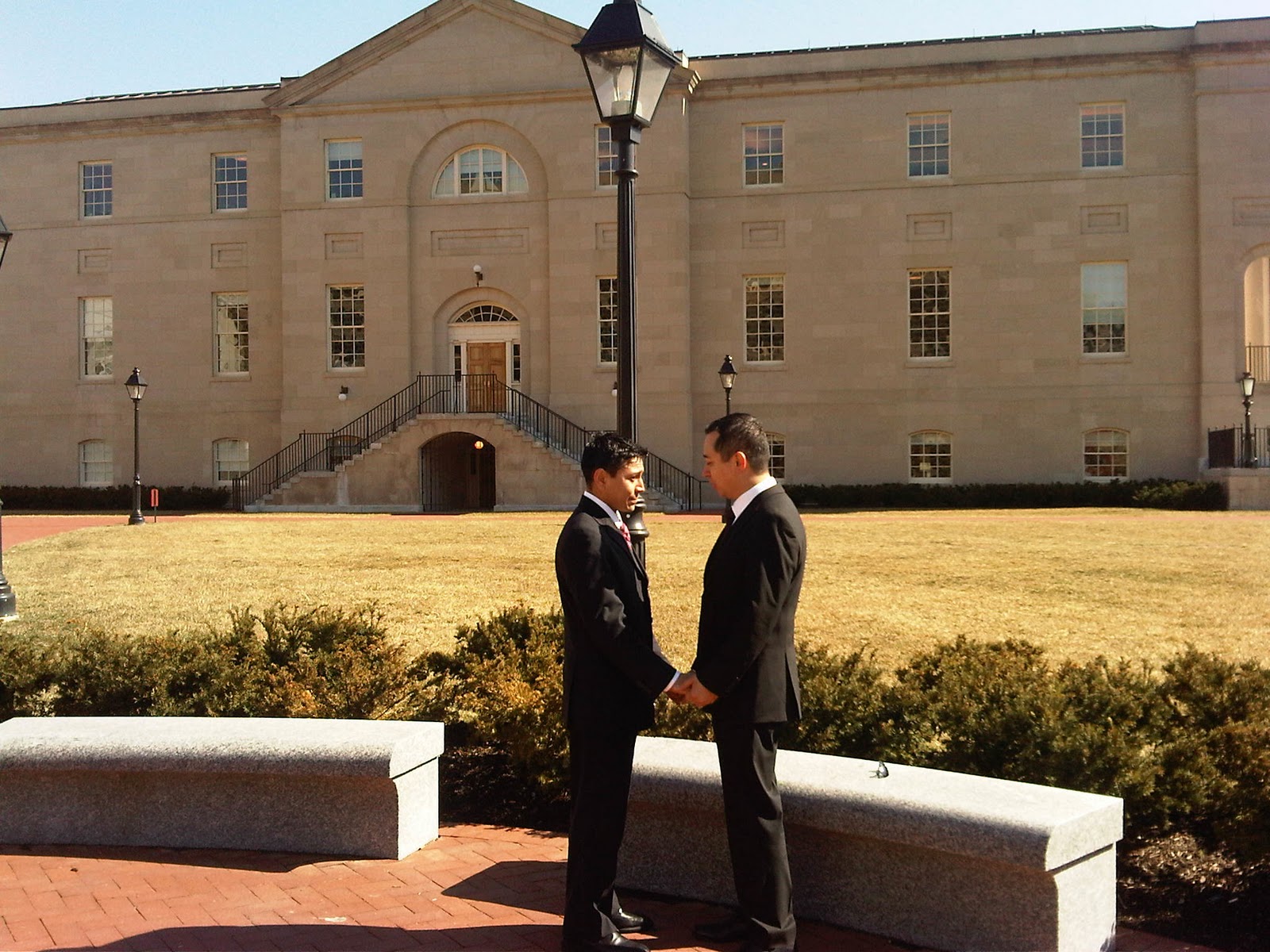
Edwin Echegoyen and Ricardo Martinez were married
by Professor Ed Ingebretsen on March 1, 2011
Ingebretsen was ordained as a Jesuit Priest in 1981
and is outspoken on issues of religion and culture.
Edwin Echegoyen and Rodrigo Martinez were married on the promenade outside the D.C. Superior Court on March 1 before a group of two dozen friends, family and co-workers. Immediately after the ceremony, Edwin, an American citizen, filed an I-130 Alien Relative Petition with U.S. Citizenship and Immigration Services requesting a "green card" for his spouse, who is a citizen of El Salvador.

After 8 years together, Edwin and Rodrigo have only five days left to stop the Department of Homeland Security from executing a deportation. Rodrigo has been ordered to surrender himself to the custody of DHS on Wednesday March 9. (Read more about Edwin and Rodrigo here.)

Please help us stop the deportation of Rodrigo Martinez.

Call both the DC and local offices of Edwin & Rodrigo's United States Senators:
Senator Barbara Mikulski (202) 224-4654 and (410) 962-4510
Senator Benjamin Cardin (202) 224-4524 and (301) 762-2974
Representative Chris Von Hollen (202) 225-5341 and (301) 424-3501

Ask them to contact the Department of Homeland Security Deportation Unit in the Baltimore Field Office immediately.


We only have 5 days left to stop this deportation.  The information you need:  RODRIGO MARTINEZ-RODRIGUEZ (File No. A 96 336 082).

In response to the Edwin & Rodrigo's case, two members of Congress this week publicly called for a halt to "DOMA Deportations" (see here and here).  Please ask the Washington, DC staff of Senators Mikulski and Cardin and Congressman Chris Van Hollen to join Rep. Zoe Lofgren and Rep. Jerrold Nadler and issue a public statement calling on the the Obama administration to halt "DOMA deportations."


Thursday, March 3, 2011

DOMA, Immigration, and ENDA: The Ripple Effects of Heightened Scrutiny


From Towleroad, DOMA: The Ripple Effects of Heightened Scrutiny, by Ari Ezra Waldman.
"But, the DOMA decision will have more direct impact. For example, Lavi Soloway, an attorney friend of mine, leading advocate of gays in immigration cases and founder of Stop the Deportations: The DOMA Project, has taken the DOJ's position and argued that since it is DOMA that is forcing legally married binational same-sex couples to be ripped apart -- DOMA prevents the federal recognition of their marriage, thus preventing a foreign national spouse from legally remaining in the United States -- the Administration's view that DOMA is unconstitutional should, at a minimum, become part of immigration officials' decision-making process when it comes to how to proceed with deporting the foreign national spouse of legally married same-sex couples.
Mr. Soloway's position raises an important distinction -- the difference between defending a law in court and enforcing the law in practice. He is essentially arguing that the DOJ's official statement that DOMA is unconstitutional should inform the opinions of the the Board of Immigration Appeals (BIA), a fifteen-judge panel that serves as the highest administrative body for interpreting immigration laws. Mr. Soloway is right. The Huffington Post implies that Mr. Soloway is asking that the Administration stop enforcing DOMA through "innovative strategies" to ensure families can stay together. That is not the case. Mr. Soloway is asking immigration officials to include the Administration's view of DOMA's constitutionality as part of the context in which the officials decide how to proceed with binational same-sex couples. Whether the immigration judge grants continuances (delays), deferred action (holding deportation in abeyance) or administrative termination (almost like ending the deportation proceeding) is up to the judge's discretion. So, Mr. Soloway wants to make sure that these judges take the Administration's view of DOMA into account."

Wednesday, March 2, 2011

DOMA Deportations: What the President Can Do

From the Washington Blade. Full story here. While this article does not produce much diversity in response to its rhetorical headline, The DOMA Project is included here as an example as one very real ways in which the executive branch can re-evaluate the landscape of deportation proceedings for development of public policy to address urgent humanitarian crises.
Amid this debate, another LGBT advocate is drawing on the recent change in how the Obama administration is handling DOMA to press the administration to exercise prosecutorial discretion in cases involving bi-national same-sex couples.

Lavi Soloway, an attorney with Masliah & Soloway PC in New York, is representing three married, same-sex bi-national couples in New York, New Jersey and California who are facing deportation proceedings.

Alex Benshimol and Doug Gentry are scheduled for a July 13 hearing in San Francisco; Monica Alcota and Cristina Ojeda are scheduled for a March 22 hearing in New York; and Henry Velandia and Josh Vandiver scheduled for a May 6 hearing in Newark, N.J. Each of the American spouses in these cases has filed green card petitions on behalf of their foreign national partners, although DOMA prevents American nationals from sponsoring their partners.

“We intend to argue as a result of the shifting position of the executive branch with respect to DOMA that it’s appropriate for the immigration judges and also for the attorneys that represent the Department of Homeland Security to exercise what’s called prosecutorial discretion, which simply means exercising more discretion in how to proceed with these cases,” Soloway said.

In the three pending cases, Soloway is asking for judges to consider changes that were made to how the Obama administration is handling DOMA in court and to put off deportation proceedings until another time when different relief of legal options may be available. According to Soloway, if anyone in these cases is deported, they won’t be able to return to the United States for another 10 years, even if DOMA is repealed or overturned sometime before then.

“I’m calling on the Department of Homeland Security … to develop reasonable innovative policy to deal with the particular moment that we’re in,” Soloway said. “We’re just in a very short-term moment where things are in a state of flux. I’m not asking them to stop enforcing any law; this is part of enforcing the law.”

Breaking News: Rep. Zoe Lofgren Calls on Obama Administration to Defer DOMA Deportations

Rodrigo & Edwin
celebrating their marriage
Full updated Advocate article here.
On Wednesday, Rep. Zoe Lofgren of California, ranking member of the House Judiciary Subcommittee on Immigration Policy and Enforcement, told The Advocate that she agrees with Nadler on deferring deportation proceedings in cases involving married, gay binational couples such as Echegoyen and Martinez: "I think [DOMA] is unconstitutional and that the federal government ought to respect couples who have married in states that permit marriage," she said.

Lofgren said she has friends and constituents in her San Jose, Calif. district facing immigration challenges as a result of DOMA. "It's a heartbreaking situation across the United States," she said. "This administration, as with any administration, has tremendous flexibility under current law to make its own judgment for fair treatment" of such couples.

Breaking News: Congressman Nadler Calls for Halt to DOMA Deportations

"An Evolving Immigration Landscape," The Advocate, March 2, 2011. Full article here.
Soloway has argued that executive branch agencies, including the Executive Office of Immigration Review and Immigration and Customs Enforcement, should “develop innovative strategies” to keep binational gay couples together pending Congressional resolution.

The administration has not yet formulated a policy on deportation cases involving married binational gay couples following the DOMA announcement last week. But Soloway pointed out that DHS in recent years has amply used its powers of discretion in other removal situations. In 2009 it issued a moratorium against deporting widows or widowers of U.S. citizens who had been married for less than two years while Congress worked on a legislative fix supported by the administration. Last year the department offered "deferred action" to allow students eligible for legal status under the DREAM Act to remain in the country and avoid deportation (Congress failed to pass the bill in December).

“What we’re talking about here is a small group who faces deportation—the ultimate punishment in an immigration context—and we’re talking about priorities,” Soloway said. “And every day the executive branch makes decisions on how to expend its resources.”

Rep. Jerrold Nadler of New York, who said last week that he would reintroduce a bill to repeal DOMA, said that while the administration has made clear that it would continue to enforce the law, “If it’s the case of a legally married couple under the laws of a state or the District of Columbia, the administration ought to argue in court not to deport them.”

Nadler is also sponsor of the Uniting American Families Act, legislation that would give gays and lesbians the right to sponsor a non-citizen partner or spouse for legal residency. “I’ve always said that UAFA is not a gay marriage bill,” Nadler said, “but I’ve also always said that if DOMA were ever repealed, and that if gay marriage were recognized, the bill would be [unnecessary]. … If DOMA is unconstitutional, then immigration law should apply equally to anyone legally married under state law.”

Tuesday, March 1, 2011

Just Married! Together for Eight Years, Edwin & Rodrigo Fight to Stop a March 9 Deportation

Edwin Echegoyen and Rodrigo Martinez
On Tuesday March 1 Edwin Echegoyen and Rodrigo Martinez of Rockville, Maryland exchanged vows of matrimony at the DC Superior Court on Indiana Avenue in Washington, D.C. Like most newlyweds, they had made the journey from courtship to cohabitation, with their love growing stronger year after year. After nearly eight years together as a couple, their lives fully integrated, and their commitment to each other stronger than ever, they decided to marry. Edwin, an American citizen, and Rodrigo, a citizen of El Salvador, were hoping to hold out until they could marry in their home state of Maryland. The news on that front had been very optimistic. Maryland is currently poised to pass a Marriage Equality bill that had sailed through that state's Senate by a comfortable margin on February 24.  Still, that bill may not become law for a few months and Edwin and Rodrigo could wait no longer. Last month they were informed by the Department of Homeland Security that Rodrigo would have to surrender for deportation on March 9. With deportation looming, they knew that this was their time.   They had to marry while they still had the chance.  On Wednesday February 23 their plans to marry received an endorsement of sorts. The White House announced that it would not longer defend a law that discriminated against same-sex marriages.  It seemed that everything was coming together. Edwin and Rodrigo called their friends and family and soon a pre-wedding celebration was planned. It took place last week, at a gathering where the couple was wined and dined and toasted.  Everyone wished them well for a future full of happiness, but Edwin and Rodrigo knew that the immediate future was going to be very challenging. Dark clouds had gathered on the horizon for this couple.  The deportation letter without warning, came after years of struggling to obtain legal status without success. Like other gay binational couples, the normal remedy—immigration in which the American sponsors the foreign spouse—was foreclosed to them because of the Defense of Marriage Act.

By Edwin Echegoyen

2003 was an eventful year for me. My mother was diagnosed with terminal stomach cancer, and I met the love of my life, Rodrigo Martinez. Back then I did not realize how these two events would come to impact my life, but even then I had a strong sense that that my life would not ever be the same.

Until I met Rodrigo, I guess you could say that I was unsuccessful at dating; I never met anyone with whom I clicked. Tried as I might to find a mate that special person eluded me. I believe this stemmed from my church upbringing because I grew up as a born-again evangelical Christian. When I was 15, I left El Salvador to join my father and stepmom in the United States. At that age I did not have a firm understanding of my sexual orientation, but I wrestled with the realization that I was attracted to other guys. It would prove to be a long journey.

With a career as a federal employee well underway, I had almost completed my Master Degree, when, in my final semester of school in 1999 I got engaged to a woman. In my mind it was the perfect timing: to finish my Master’s Degree, plan a wedding and start a family. That was what was expected of me by my family and I was eager and willing to fulfill my new roles as husband and father. And as you might expect, the pressure I put on myself to do everything expected of me brought the house of cards crashing down. I couldn't go through with it. I broke off my engagement because I realized and accepted that I was gay and I could not lie to her and live my life as a big charade. Needless to say it took me a while to bounce back.

A few years later, I met Rodrigo at the gym. Although he was 10 years my junior, he was mature beyond his years and had a caring, generous spirit.   As our dating grew more serious, it was an easy transition for me to think of him as my life partner. He was such a sensitive and thoughtful person and everyone who came into contact with him noticed these traits. As time passed, he came to know my mother and the rest of my family, and they, too, embraced him as an “adopted” relative. Our relationship developed very naturally, and before long, we started living together in the Rockville, Maryland, a suburb of Washington, DC.

Living with Rodrigo and settling down to a domestic routine was one of those things in life that is so easy to take for granted. I had never been happier. Our relationship blossomed with each year. We were mutually supportive and emotionally interdependent as a couple.

Over time we realized that we had developed a deep and abiding love for each other.  We were extraordinarily compatible. We shared the same humble origins in El Salvador; the same religious upbringing; the same language; and enjoyed the same food.  But our newfound happiness was interrupted by events in 2004. My mother, who had been struggling with her terminal diagnosis, took a dramatic turn for the worst and died in March.  My mother's death was devastating, but the pain of such a huge loss was made bearable only because I had the incredible support and unconditional love of Rodrigo. To this day I still cannot comprehend how Rodrigo, despite being young himself, was able to summon the strength to be so strong and caring at my moment of intense grief. Rodrigo saw me through my worst moments, and he never wavered in his commitment and compassion for me.


That summer we decided to go on vacation to Puerto Rico with three other gay couples. The eight of us traversed the beautiful island creating memories and enjoying ourselves. However, on our return to the United States, Rodrigo was stopped by the authorities. Even though we were technically on a domestic flight and he had not left the United States, they caught him. He was in the U.S. on an expired visa. (I had become a naturalized U.S. citizen many years before.)

Up to that point we really had not focused much on Rodrigo's immigration status. We had settled into our routine and we had not considered the possibility that immigration officers might one day come between us. Our relationship was strong but it was also so normal, we simply took for granted that we would be able to be together for the long term. When we did turn our attention to Rodrigo's immigration status we wrongly believed that it would be a relatively simple matter for him to acquire legal status.

At the moment Rodrigo was stopped by the Immigration Officer, I knew that if I could have married Rodrigo and sponsored him to remain in the United States he would have been eligible for a green card like any other spouse of a U.S. citizen. (Even individuals who overstay visas are not barred from a green card if they are married to an American citizen.)  In those days, gay couples were just for the first time winning the right to marry in Massachusetts.  In fact, if we had married in 2004, and if U.S. immigration law had recognized that marriage, Rodrigo would have been given a "green card" and he would be a naturalized American citizen by now.  Instead, we found ourselves scrambling to hold onto any ray of hope offered by a never-coming immigration reform, and ostracized by a society that does not allow us to share the protection enjoyed by straight couples.

When Rodrigo was detained in 2004, I posted bail to allow him to remain in the country until his legal status changed. However, despite several attempts to resolve his status, we were unsuccessful. Recently I recently received a letter in the mail from the Department Homeland Security ordering me to turn Rodrigo in to the authorities on March 9 so they could deport him. To us deportation is like a death sentence. It is hard to explain how we felt when we received the letter. It was as though we were punched in the gut and could not catch our breath.

As soon as received the letter we decided to marry.  Although we had been hoping to marry in Maryland where we live but we cannot wait. If Rodrigo is deported next week after 8 years together we may never get the chance to marry.  While the urgency of the current situation has pushed us to this decision, it was definitely true for us that this next move was the natural evolution of a strong, committed relationship. We came to this decision with the love and support of our friends and family and with the hope that the recent decision by President Obama and Attorney General Holder to stop defending the Defense of Marriage Act in court will yield some short-term solution for binational couples who are fighting deportation.

Attorney General Eric Holder
We know that the Defense of Marriage Act remains in effect, but we are just asking for more time.  After 8 years as a couple, we believe that we have the right to be treated equally. Our love is the same as any other couple. Our need for our family to be protected is the same as any other.  We are not asking for special privileges. We do not even want a fancy wedding. We just want to continue living our normal everyday life as a couple with all the rights, protections and obligations extended to two people in love who have committed through marriage to care for each other.

We ask everyone who is reading this to help us stop the deportation of RODRIGO MARTINEZ-RODRIGUEZ (File Number A96 336 082) by CALLING both the DC and local offices of our United States Senators Barbara Mikulski [(202) 224-4654 and (410) 962-4510] and Benjamin Cardin [(202) 224-4524 and (301) 762-2974] to our Representative Chris Von Hollen [(202) 225-5341 and (301) 424-3501]. Ask them to contact the Department of Homeland Security Deportation Unit in the Baltimore Field Office immediately. We only have 8 days left to stop this deportation.